
Every business faces the same problem in different forms: a technician can’t find the right page in a manual, a customer’s on hold for an answer that’s already documented, someone wants to book an appointment or check pricing after hours. The information usually exists – the challenge is finding it and acting on it.
That’s where Echo7 comes in.
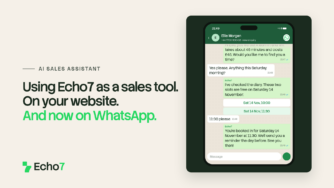
Echo7 works on two fronts. Internally, it’s the assistant your team uses to work faster. Externally, it’s the first point of contact on your website – handling enquiries, pricing questions, and bookings without anyone on your team needing to be online. And it’s not limited to a website widget: the same assistant works behind a dashboard, via an API, in messaging apps, and by email.
Your content, turned into answers
Upload your manuals, procedures, or website content, and Echo7 builds an assistant that answers from those materials specifically – not general internet responses or best guesses. If the answer isn’t in your documentation, it’s designed to say so rather than guess.
Source documents aren’t retained either – once processed, only the structured data needed to answer questions is kept, and the originals are deleted. That matters from a GDPR perspective – keeping only what’s needed, for only as long as it’s needed. It’s especially relevant for legal, healthcare, and public sector organisations.
The technology behind it: RAG
This approach has a name – Retrieval-Augmented Generation, or RAG. Instead of answering purely from what it was trained on, the AI first retrieves the most relevant information from your content, then generates its answer from that.
It’s why Echo7 can say an answer is grounded in your documentation rather than a plausible guess – and why it can tell when something isn’t in there, instead of inventing something to fill the gap.
Answers that turn into action
Answering a question is often just the start. Three things pick up from there:
Integrations. Connect Echo7 to your systems – CRM, ordering, accounting.
Agents. Carry out tasks inside those systems – placing orders, updating records.
Workflows. Tie it together, defining what happens next and when to escalate to a person.
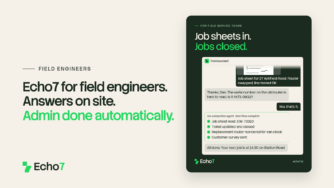
In practice: an engineer on-site hits an unfamiliar fault. They ask Echo7, which pulls the answer from the equipment’s documentation. The workflow takes it from there – CRM updated, part ordered, accounts updated – one conversation, three systems handled.

Even the messy stuff becomes usable
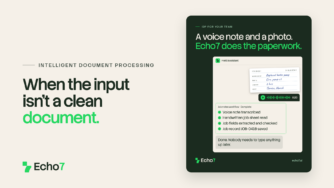
Not everything starts as a clean document. IDP (Intelligent Document Processing) turns handwritten notes and voice memos into structured data that feeds straight into a workflow – no one stuck transcribing a scribbled fault report after the fact.
Who can use Echo7?
Field engineers who need answers and follow-through in one step. Support teams tired of the same five questions. Sales teams wanting product info on tap. Hotels, museums, and public-facing venues offering accurate answers without a human on call. Public sector teams simplifying citizen information. Partners and resellers kept current without chasing someone internally.
Different industries, same frustration: too much time finding information, too much manual work once you’ve found it. Echo7 closes both gaps.
Sign up for a free trial today.
Stay in the loop
We’ll cover each of these in more depth over the coming weeks. If you’d rather not check back manually, our weekly newsletter covers what’s happening in AI more broadly, product updates, and the occasional deep dive into how Echo7 works under the hood.