












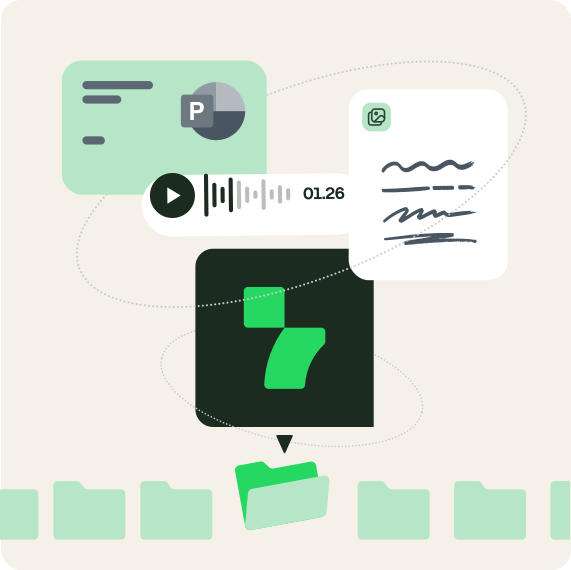
What is IDP?
Every organisation receives documents that someone has to read, check and type into another system: invoices, forms, job sheets, signed requests, identity documents, reports, images and PDFs. It is slow, repetitive and prone to error.
Echo7’s Intelligent Document Processing (IDP) transforms those documents and attachments – printed or handwritten – into usable data. It analyses each file, extracts the key information, validates it against your rules and triggers the right automated process – whether the document arrives through your website, by email, as a photo on WhatsApp or through the API.
How Echo7 processes a document
From the moment a document arrives to the moment its data is in the right system, every step is automated and traceable.
01
Receive
Documents arrive by email, upload, API or as a photo on WhatsApp – and Echo7 recognises voice messages as an input too. It identifies the document type and layout, and multiple pages or files can be combined into one case.
02
Extract
Key information – including handwriting and tables – is read and made available for checks or integrations.
03
Validate
Rules check consistency and completeness, and validation fields correct misread values and map them to your own codes.
04
Automate
The data goes to your CRM, ERP or management system as structured JSON, and Echo7 can send notifications, archive documents or ask for anything missing.

The business impact
Manual document handling is one of the biggest hidden costs in back-office work. With IDP, documents are processed in a fraction of the time, with fewer errors and far less manual effort – freeing your people to focus on exceptions and decisions instead of data entry.
Because IDP runs inside Echo7’s governed workflows, every step is traceable. You decide the validation rules, when a person needs to review a case and which systems are updated, so automation stays fast and under control. And you don’t need developers to set it up: you define what to extract and how to check it from an easy-to-use interface, then describe the next steps and Echo7 builds the workflow for you.
Software houses can even embed the review screen in their own application, so users check extracted data before it’s saved – learn about partnering with Echo7. Average document processing time becomes a KPI you can measure and improve.
Why Echo7
More than a chatbot. Echo7 responds, decides, guides and acts – combining your knowledge, your data and real actions in one experience, with governed workflows behind every step.
"*" indicates required fields
Ask our assistant
Prefer to ask? Open the assistant and ask how Echo7 would work for you – you’ll get an answer straight away.
Call +44 333 3584 877
We’re here to answer your questions, explore new ideas with you, and help find the solution that best fits your needs.
Get the weekly AI briefing
AI news, practical ideas and Echo7 updates in one short email a week.
Frequently asked questions
Didn’t find your answer? Ask our assistant – it’s trained on everything on this site.
01
What is intelligent document processing?
Intelligent document processing uses AI to read documents, extract the information they contain, validate it and trigger the next step automatically – replacing manual reading and data entry. Setting up a new document process requires no coding experience.
02
Which documents can Echo7 process?
Invoices, forms, signed requests, identity documents, reports, images and PDFs, including multi-page documents and multiple attachments combined into a single process.
03
How does IDP fit with our existing systems?
Extracted data is delivered as structured JSON with your own codes, ready to pass to your management systems through Echo7’s integrations, and workflows can archive documents, send notifications or update records automatically.
04
Can documents be submitted via WhatsApp or email?
Yes. Documents can arrive through digital channels including your website, email and WhatsApp, where they are classified and queued for processing.
05
What happens if information is missing or wrong?
Validation rules flag inconsistencies, incomplete data and anomalies. The workflow can ask the user for more information or route the case to a person for review.